Money
The Financial Impact of Using a Rent vs Buy Calculator

AheadFin Editorial
Mar 24, 2026·10 min read

AheadFin Editorial
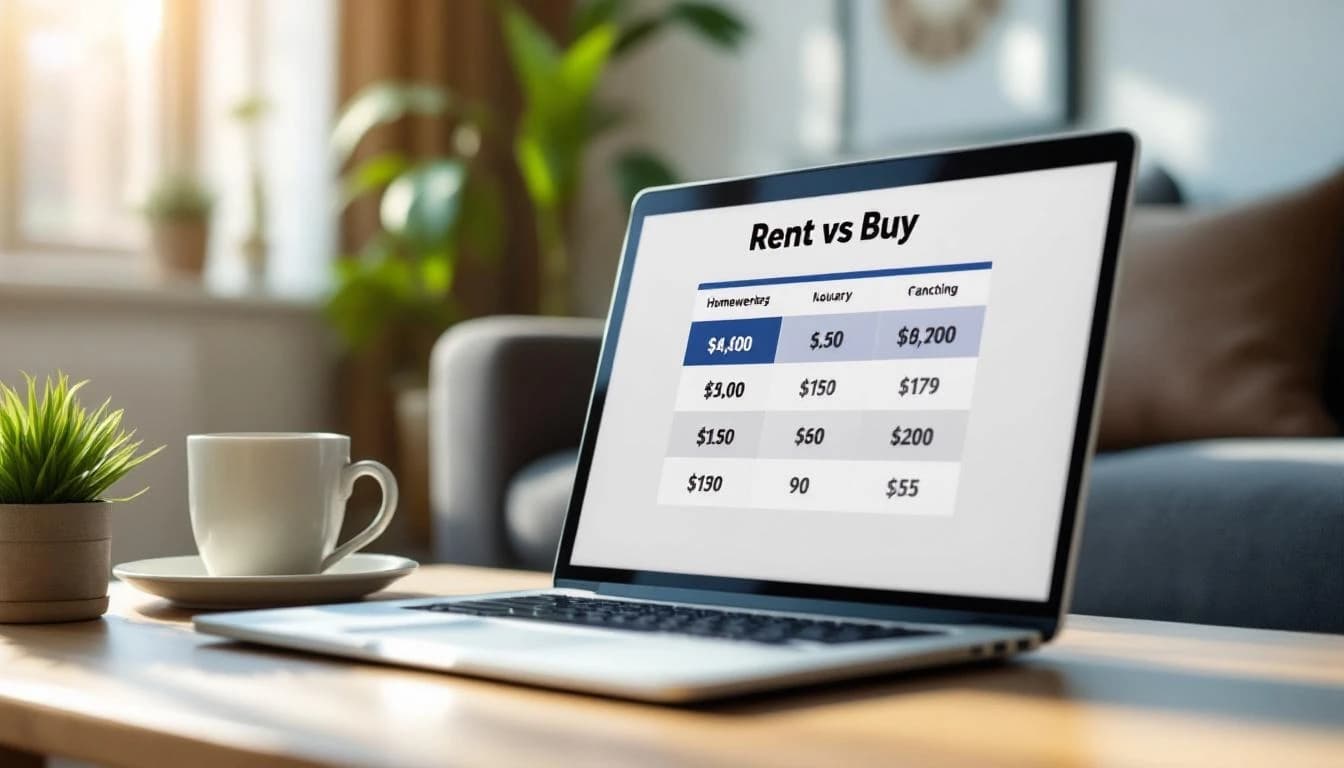
Olivia, a 32-year-old graphic designer, stares at the real estate listing on her laptop. The two-bedroom condo she’s eyeing. priced at $250,000. seems within reach. But with a monthly rent of $1,200 for her current apartment, she's torn. Should she explore homeownership or continue renting? Both options have their merits, and she wonders which is financially wiser over the next decade. This is a common dilemma, and the answer often lies in crunching the numbers with a rent vs buy calculator.
The rent vs buy decision isn't just about monthly payments; it's a complex financial choice. When you buy, you gain an asset, potentially build equity, and benefit from tax deductions. Renting, however, offers flexibility, fewer maintenance hassles, and no property taxes. But how do you know which is more suitable for your situation?
Understanding the financial implications of both scenarios is important. A comprehensive tool like the Rent vs Buy Calculator can illuminate the path by comparing long-term costs and savings.
To get a clearer picture, imagine Olivia uses the calculator: she inputs her potential $250,000 condo purchase with a $50,000 down payment. The calculator reveals:
Now, compare this with her current rent of $1,200, which is likely to increase annually. Over a decade, renting might cost her upwards of $158,000 without the benefit of building equity.
Renting may be advantageous for those who prioritize flexibility or expect to move frequently. With no need for a hefty down payment, it frees up cash for investments or other purposes. Maintenance issues are typically the landlord’s responsibility, not yours.
However, the lack of long-term financial benefits can be a drawback. Rental payments don’t contribute to an asset. As rents rise, costs can escalate without the offsetting advantage of property appreciation or tax breaks.
| Scenario | Monthly Payment | Total 10-Year Cost | Equity Built | Tax Benefits |
|---|---|---|---|---|
| Renting | $1,200 | $158,400 | $0 | $0 |
| Buying | $1,266 | $151,920 | $72,000 (approx.) | $15,000 |
This table showcases how buying, despite similar monthly costs, builds equity and offers tax benefits, making it a financially sound option over time.
Homeownership provides stability and the opportunity to build wealth through equity. Additionally, as mortgage payments remain relatively steady, they may become more manageable compared to rising rents.
For instance, Olivia finds that owning her condo could mean accruing around $72,000 in equity over ten years. The rent vs buy break even calculator shows that her break-even point, where owning becomes cheaper than renting, is after 7 years.
The downsides? Upfront costs like the down payment, closing fees, and ongoing maintenance need consideration. Plus, if home values don’t appreciate or if Olivia needs to move sooner than expected, the financial benefits might lessen.
The Rent or Buy Comparison Calculator offers a down payment impact analysis. For instance:
Finding the optimal down payment can significantly affect long-term financial outcomes.
Choosing whether to rent or buy hinges on several factors: financial readiness, lifestyle preferences, and market conditions.
If Olivia expects to remain in her locale for a decade and can comfortably handle a mortgage, buying might be beneficial. But, if job mobility or financial flexibility is a priority, renting could be the way to go.
To make an informed decision, input your specifics into a tool like AheadFin's Rent vs Buy Financial Tool. Here’s how:
Let’s assume a $300,000 home with a 10% down payment. The calculator might show:
The clarity and insights from these calculations make such decisions less daunting.
Interest rates significantly influence the cost of buying a home. A lower interest rate means you'll pay less over the life of your mortgage, while a higher rate increases your total cost. For example, consider a $300,000 mortgage:
This $124,000 difference illustrates how even a small change in interest rates can impact long-term affordability.
Though not directly tied to interest rates, rental prices can fluctuate based on market conditions influenced by rates. When interest rates rise, fewer people may afford to buy homes, increasing demand for rentals and potentially driving up rents. Conversely, lower rates might encourage more home purchases, easing rental demand.
Consider a scenario where interest rates rise by 1%. If this shift results in a 5% increase in rental prices, a $1,500 monthly rent could increase to $1,575. Over a year, that's an additional $900.
| Scenario | Monthly Rent | Annual Rent | Increase Over Year |
|---|---|---|---|
| Initial Rent | $1,500 | $18,000 | $0 |
| Rent After 5% Rise | $1,575 | $18,900 | $900 |
Understanding these dynamics helps in weighing the cost implications of each choice.
Owning a home comes with potential tax advantages, primarily through mortgage interest deductions. Suppose you pay $10,000 in mortgage interest annually. If you're in the 24% tax bracket, this could reduce your taxable income by $2,400. Such deductions can make ownership more appealing financially.
Also, capital gains tax exemptions can apply when selling a primary residence. If you sell a home as a single filer, up to $250,000 of the gain may be tax-free; for joint filers, this limit is $500,000. Suppose you bought a home for $200,000 and sold it for $450,000. As a single filer, the $250,000 gain would be fully exempt from capital gains tax.
Renters don't enjoy the same tax benefits as homeowners. However, they might qualify for renter's credits in some states, though these are generally modest. For instance, if a state offers a $200 renter's credit, it’s a minor offset compared to potential homeownership deductions.
Renters may also benefit from tax savings indirectly by investing savings from not owning a home. Suppose you save $10,000 annually by renting instead of buying and invest this amount, earning a 5% return. After 10 years, your investment could grow to approximately $125,000.
| Year | Annual Savings | Investment Value |
|---|---|---|
| 1 | $10,000 | $10,500 |
| 5 | $10,000 | $55,256 |
| 10 | $10,000 | $125,779 |
These figures highlight how tax considerations can tilt financial decisions.
Homeownership is often touted for its equity-building potential. As you pay down your mortgage, your equity increases, providing a financial asset. For example, after 10 years of payments on a $300,000 mortgage at 4% interest, you might owe about $236,000, giving you $64,000 in equity if the home's value remains stable.
In contrast, renting allows for potentially greater investment flexibility. If renting saves you $500 monthly compared to owning, investing this amount at a 6% annual return could yield significant growth over time. After 10 years, this investment could grow to around $81,000.
| Year | Monthly Savings | Investment Value |
|---|---|---|
| 1 | $6,000 | $6,360 |
| 5 | $6,000 | $34,719 |
| 10 | $6,000 | $81,433 |
Your lifestyle and long-term goals profoundly influence the rent vs. buy decision. Consider Emily, a professional who values flexibility for career moves. Renting allows her to relocate without the constraints of selling a home. Alternatively, Mark, who plans to settle in one area for many years, might prioritize homeownership as a way to stabilize housing costs and build equity.
Assessing your future plans, risk tolerance, and financial priorities will guide whether renting or buying aligns with your personal and financial aspirations.
Owning a home isn't just about paying the mortgage. Maintenance and repairs can significantly impact your budget. On average, homeowners spend 1% to 3% of their home's value annually on upkeep. For a $300,000 home, this translates to $3,000 to $9,000 each year. Unexpected repairs, like a leaky roof or faulty plumbing, can further strain finances.
Here's a quick breakdown of potential yearly costs:
| Item | Estimated Annual Cost ($) |
|---|---|
| Lawn Care | 500 |
| HVAC Maintenance | 200 |
| Roof Repairs | 1,000 |
| Plumbing | 300 |
| General Repairs | 1,500 |
| Total | 3,500 |
Another often overlooked expense is homeowner's insurance. Premiums vary based on location, home value, and coverage level, averaging around $1,200 annually in the U.S. For high-risk areas, costs can soar. This insurance is important for protecting your investment against damages and liabilities, but it's a recurring expense that renters typically avoid.
Renting provides flexibility, allowing easy relocation with minimal hassle. Homeowners face significant costs when moving. Selling a home involves real estate agent fees, typically 5% to 6% of the home's sale price. For a $350,000 home, this amounts to $17,500 to $21,000. Additionally, closing costs for the buyer can range from 2% to 5%, adding to the seller's overall expense.
Homeownership ties up capital, potentially limiting other investment opportunities. If you invest a $50,000 down payment in a diversified stock portfolio with a 7% annual return, that’s $3,500 in potential earnings the first year alone. Compare this to the equity built through mortgage payments, and the financial picture becomes more complex. Renting might allow for more liquid investment strategies, offering better returns in certain scenarios.
Real estate markets vary widely. In cities like San Francisco, where median home prices exceed $1.2 million, renting often proves more economical. Conversely, in areas with lower property values, buying might be advantageous. Understanding local trends is important. For example, a 5% annual home price increase in a growing market can significantly boost home equity, whereas stagnant or declining markets might favor renting.
Rental prices also fluctuate, impacting the rent vs buy decision. In cities experiencing an influx of residents, rental demand can drive prices up. In contrast, areas with high vacancy rates might see rental reductions. Analyzing these dynamics helps determine the relative financial benefits of renting versus buying in your region.
By considering these factors, you can make a more informed decision tailored to your financial situation and lifestyle preferences. For those seeking a detailed analysis, AheadFin's converter offers insights into how these variables interact in your specific scenario.
Evaluate your financial readiness, long-term plans, and local market conditions. Consider the costs associated with both renting and owning, like maintenance, taxes, and potential appreciation.
The tool calculates the break-even month by comparing cumulative costs of renting and owning, factoring in equity and tax benefits to identify when owning becomes financially preferable.
Yes, a smaller down payment can lead to higher PMI costs and a delayed break-even point. However, it also leaves more cash available for other investments or expenses.
The calculator allows you to compare the opportunity cost of investing your down payment in the S&P 500 against building home equity. It can help assess which option might yield better financial returns.
Yes, it includes mortgage interest and property tax deductions, adjusted for the SALT cap, providing a more accurate picture of potential tax savings.
One email a week with money tips, new tools, and insights you can actually use.
Delivered every Monday.